
Beschrijving
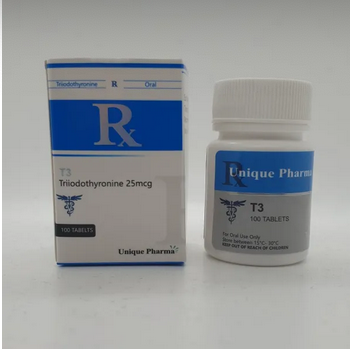
T3 25Mg
T3 Liothyronine microgram is a medicine in the form of tablets. T3 Liothyronine 25 microgram tablets are white and round and have a double score line in the shape of a cross on both sides. The active substance in T3 Liothyronine 25 microgram is Liothyronine. A Global Farma Liothyronine sodium 25 microgram tablet contains 25 micrograms of Liothyronine. T3 Liothyronine 25 microgram in packs of 100 tablets of 0.25 mg
Drug group
T3 Liothyronine belongs to the group of medicines called ’thyromimetics’. Thyromimetics exert the same effect as thyroid hormone and can reverse the effects of reduced thyroid function.
The human thyroid produces two hormones: triiodothyronine (T3 or liothyronine) and tetraiodothyronine (T4 or thyroxine). The inactive T4 is converted in the body into the active T3, which exerts its effect while simultaneously inhibiting the conversion of T4 into T3 (thereby ensuring proper regulation). T3 has many functions in the body: it is involved in the development of the nervous system, growth, and regulates the level of human metabolism. If your thyroid does not function or functions abnormally, you receive too little active thyroid hormone. Liothyronine sodium Global Farma 25 micrograms is equivalent to this and can reverse the consequences of the thyroid hormone deficiency.
Therapeutic indications
T3 Liothyronine 25 micrograms is used, among other things:
- for the treatment of the consequences of mild to severe thyroid impairment;
- to reduce an enlarged thyroid gland (“goiter”);
- to test thyroid function (T3 suppression test).
When should you not use this medicine or when should you be extra careful with it?
T3 Liothyronine 25 micrograms must not be used by patients:
- who are hypersensitive to one or more of the components of Liothyronine sodium Global Farma 25 micrograms;
- with impaired adrenal cortex function;
- with a specific kidney disorder (“nephrotic syndrome”);
- with insufficient development and function of the reproductive organs.
Your doctor or pharmacist can provide you with further information about this.
Be extra careful with T3 Liothyronine 25 micrograms
- When you start using T3 Liothyronine 25 micrograms after treatment with other thyroid medicines (thyroglobulin or levothyroxine), account must be taken of any residual effects of these medicines and the rapid onset of action of Liothyronine 25 micrograms, and the dosage should be adjusted accordingly.
- When you suffer from heart and/or vascular disease. In particular, if you suffer from insufficient heart function, you must inform your doctor about this.
- When you have a specific skin condition and reduced metabolism (myxedema) as a result of thyroid dysfunction, patients may react severely to thyroid medication, and therefore treatment must be started cautiously.
- When your adrenal cortex function is reduced due to a prolonged and severe reduction in thyroid function. Your doctor will first treat the reduced adrenal cortex function before starting treatment with Liothyronine 25 micrograms.
- When you have a reduction in the function of the anterior lobe of the pituitary gland (a specific center in the brain that produces hormones). Your doctor will therefore first treat the reduced adrenal cortex function before starting treatment with Liothyroninea 25 micrograms.
Consult your doctor if any of the above warnings apply to you, or have applied in the past.
Pregnancy
Liothyronine 25 micrograms can, as far as is known, be used without objection during pregnancy. The dosage may be adjusted during pregnancy. If you are pregnant, you can use Liothyronine in close consultation with your doctor. If you suffer from hypothyroidism, Liothyronine is not recommended during pregnancy. Your doctor will then prescribe another medicine. Ask your doctor or pharmacist for advice before taking any medicine.
Breastfeeding
If you are breastfeeding, you can use Liothyronine in consultation with your doctor. Ask your doctor or pharmacist for advice before taking any medicine.
Driving skills and the use of machines
There are no data regarding the influence of Liothyronine on driving ability and the ability to operate machinery, but given its mechanism of action, no influence is expected.